
Finding quality renal medicine training in the UK can feel overwhelming. You need more than basic rotations—you need a mentor who transforms your understanding of nephrology.
Generic training programs offer limited transplant exposure and minimal international perspective. Your career deserves better than standard supervision.
Train with Prof. Aimun Ahmed at Lancashire Teaching Hospitals, where 30+ years of expertise, 5,000+ patients managed, and 1,000+ transplant cases create unparalleled learning opportunities in renal medicine.
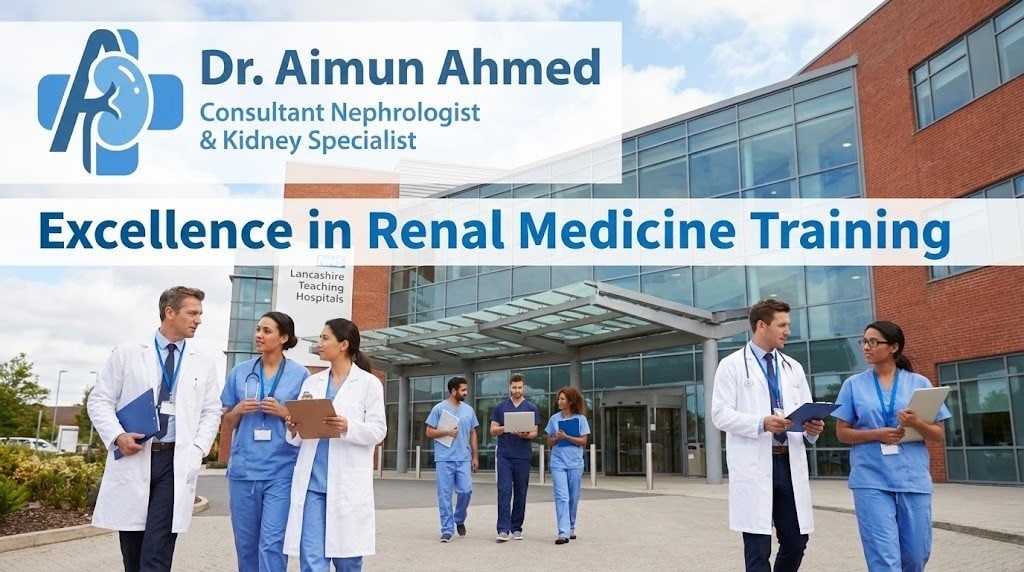
Table of Contents
About Prof. Aimun Ahmed: Three Decades of Excellence
Prof. Aimun Ahmed is a Consultant Nephrologist and Kidney Specialist at Lancashire Teaching Hospitals NHS Foundation Trust. His career extends far beyond patient care—he’s dedicated to shaping the next generation of kidney specialists.
With over three decades of experience managing more than 5,000 patients, Prof. Ahmed grounds his practice in safety, precision, and evidence-based medicine. His expertise spans chronic kidney disease, transplant medicine, and hypertension management. What sets him apart is his commitment to education.
Prof. Ahmed has trained physicians and nurses from 48 countries, delivering specialized courses across 15 nations. His international teaching experience brings global perspectives to UK-based training, exposing trainees to diverse clinical approaches and cutting-edge protocols used worldwide.
His involvement with international organizations, including the Croatian Transplantation School, ensures his training methods remain current with the latest advances in nephrology and transplantation. This global network benefits every trainee who works with him, offering connections and knowledge that extend far beyond Lancashire.
Why Train with Prof. Ahmed?
Choosing where to complete your renal medicine training shapes your entire career. Prof. Ahmed’s program offers distinct advantages that standard rotations cannot match.
Transplant Expertise You Won’t Find Elsewhere
With over 1,000 transplant cases managed, Prof. Ahmed specializes in living donor kidney transplantation. You’ll gain hands-on experience assessing donors, understanding immunological matching, managing post-operative complications, and providing long-term recipient care. This depth of transplant exposure is rare in general nephrology training.
International Perspective
Having trained professionals from 48 countries, Prof. Ahmed understands how to communicate complex concepts across cultural and linguistic barriers. This skill—making genomic data, immunology, and treatment protocols accessible—is something you’ll develop under his mentorship. It’s invaluable whether you practice in the UK or abroad.
Multidisciplinary Collaboration
You’ll work alongside surgeons, radiologists, specialist nurses, and other nephrologists in a truly collaborative environment. This team-based approach mirrors real-world consultant practice, where managing kidney disease requires coordinating multiple specialists to provide holistic patient care.
Evidence-Based Teaching
Prof. Ahmed emphasizes why treatments work, not just what to prescribe. Understanding the evidence behind clinical decisions develops critical thinking skills that serve you throughout your career. You’ll learn to evaluate research, apply guidelines appropriately, and adapt treatment plans based on individual patient circumstances.
Clear Communication Skills
Known for explaining complex medical concepts simply, Prof. Ahmed models the communication skills every consultant needs. Whether discussing genomic factors with colleagues or explaining dialysis options to anxious patients, clarity matters. You’ll develop this skill through observation and practice.
Understanding Renal Medicine Training UK NHS
To succeed, you must understand the system. The pathway for renal medicine training uk within the NHS is rigorous and respected worldwide. It is structured to produce specialists who are dual-accredited.
This means that upon completion, you are not just a kidney specialist; you are also a Consultant in General Internal Medicine (GIM). This dual accreditation is essential because renal patients often present with multi-system symptoms. Trainees must be capable of managing the unselected acute medical take alongside their specialty practice. The training ensures physicians can handle everything from chronic failure to hypertensive emergencies.
Internal Medicine Training UK Requirements
Before you can pursue a career in this field, you must lay a strong foundation. Entry into a renal programme is competitive.
Generally, you need to have completed the Foundation Programme (F1 and F2). Following this, you must undertake Internal Medicine Training (IMT) for two to three years. A crucial requirement is passing the full Membership of the Royal College of Physicians (MRCP) examination. Prior to applying for a Higher Specialty Training (ST4) post, you must demonstrate your commitment to the specialty, perhaps by displaying audit work or research in a relevant area.
The 4-Year Training Programme Structure
Once accepted, you enter a dedicated 4-year training programme. This is where your career truly accelerates. The programme is overseen by the Joint Royal Colleges of Physicians Training Board (JRCPTB).
- Years 1-2: The focus is on core nephrology, managing acute kidney injury, and supervising dialysis units. You will learn the basics of haemodialysis and peritoneal dialysis.
- Year 3: You will develop specialist interests, such as transplantation or interventional nephrology.
- Year 4: The final stage involves acting up as a consultant, leading the team, and focusing on service development and management.
During this time, you may rotate through different hospitals, including tertiary centers in regions like the West Midlands or the North West, to ensure a comprehensive range of clinical exposure.
Mastering the Renal Curriculum
The renal curriculum is the blueprint for your training. It is monitored by the members of the Renal SAC (Specialty Advisory Committee) to ensure high standards are maintained.
The curriculum covers common and rare conditions. You must demonstrate knowledge in:
- Hypertension management.
- Fluid and electrolyte balance.
- Genomic factors in renal disease.
- Palliative care in advanced kidney failure.
- Glomerular and tubulointerstitial diseases.
Assessments are frequent, ensuring that you are consistently improving and meeting the requirements for accreditation.
What is a Renal Medicine Specialist?
A renal medicine specialist, often called a nephrologist, is a physician who focuses on the diagnosis and treatment of kidney diseases. But the role is much broader than just prescribing medicine.
These specialists are leaders in healthcare. They manage chronic kidney disease (CKD) to prevent progression. They oversee life-saving renal replacement therapy. They are also pivotal in the transplant process, managing the delicate balance of the immune system in the recipient. Whether called a renal medicine name like “Renal Physician” or “Nephrologist,” the goal is the same: to improve patient health and quality of life.
Prof. Ahmed’s Training Philosophy
“Education is not just about passing exams; it is about building a sustainable career,” says Prof. Ahmed. His philosophy focuses on practical, ethical, and culturally sensitive training.
- Hands-On: Trainees are not passive observers. You apply your skills in real-time, managing intensive care scenarios under supervision.
- Ethical: There is a strong focus on the ethics of donor organs and patient autonomy.
- Collaborative: He teaches that you are a partner in the patient’s journey.
- Lifelong Learning: He encourages engagement with the wider nephrology community, including the work of peers like Vinodh Devakumar, to stay abreast of new research.
Clinical Experience: Acute and Chronic Care
Under Prof. Ahmed’s mentorship, you will gain experience across the full spectrum of the specialty.
You will face high-pressure situations where patients have rapid loss of kidney function. Quick diagnosis and intervention are key. You will learn to manage these patients in the intensive care unit, providing rapid support.
In outpatient settings, you will manage long-term conditions. You will learn to support people as they navigate the stages of CKD, preparing them for dialysis or transplantation. This requires patience and the ability to build long-lasting relationships with patients.
Transplantation Training Excellence
Transplant medicine is a highlight of Prof. Ahmed’s service. With his vast experience, he offers trainees a unique window into this complex field.
You will learn about:
- Donor selection and safety.
- Immunology and tissue typing.
- Post-operative care and managing rejection.
- Long-term monitoring of the recipient.
His involvement with international bodies, such as the Croatian Transplantation School, ensures that the training you receive is globally relevant and up to date with the latest advanced protocols.
Academic and Research Opportunities
For those who wish to pursue an academic path, there are numerous opportunities. Many trainees take time out to study for an MSc or a Diploma in Nephrology.
Research allows you to explore the primary causes of kidney injury or develop new treatment strategies. Senior renal physicians like Prof. Ahmed actively encourage participation in clinical trials and audits. Publishing your findings helps you displaying your expertise to the wider medical community.
Advanced eLearning Courses and Resources
Medicine is a digital profession. Advanced eLearning courses are an integral part of modern training. Online modules allow you to study theoretical aspects of the curriculum at your own pace.
These resources are essential for preparing for the Specialty Certificate Examination (SCE). They cover everything from basic physiology to complex genomic disorders. Utilizing these tools ensures that your knowledge is comprehensive and that you are ready to function as a consultant.
Frequently Asked Questions
How to become a renal consultant in the UK?
To become a consultant, you must first complete your medical degree and Foundation training. You then need to complete 2-3 years of Internal Medicine Training (IMT) and pass the MRCP. After this, you apply for a higher specialty training post in Renal Medicine (usually combined with GIM), which typically lasts four to five years. Upon successful completion, you receive your CCT and can apply for consultant jobs.
How to learn renal medicine?
You learn through a mix of clinical rotations, mentorship, and self-study. Hands-on experience in hospitals managing patients with kidney disease is crucial. This is supplemented by studying the renal curriculum, attending university lectures, and utilizing advanced eLearning courses.
What is a kidney specialist called in the UK?
In the UK, a kidney specialist is formally known as a Consultant Nephrologist or a Renal Physician. Both terms are used interchangeably in healthcare settings.
Does Prof. Ahmed accept international trainees?
Yes. Ahmed has trained professionals from over 48 countries. He welcomes international medical graduates for observations and fellowship opportunities.
What makes this transplant training unique?
With over 1,000 transplant cases and a specific focus on living donor transplantation, the programme offers a volume and depth of experience that is rare. You gain practical insights into the ethical and clinical aspects of complex transplant medicine.
About Prof. Aimun Ahmed
Prof. Aimun Ahmed is a leading Consultant Nephrologist & Kidney Specialist. With over 30 years of experience, he delivers world-class care at Lancashire Teaching Hospitals. He specializes in Chronic Kidney Disease (CKD), Transplant Medicine, and Hypertension, offering evidence-based, compassionate care to patients globally.